
Before you arrive
Entry visa and regulations, housing options at the MPI-IE, translation and legalisation of documents.
When you start working at the MPI of Immunobiology and Epigenetics you have to comply with several legally required formalities. You will soon negotiate the initial steps and the International Office, the IMPRS Office and your hosts at the MPI-IE will be happy to help you throughout your stay. In our MPI-IE Welcome Guide you will find comprehensive information about what to do in preparation for your departure for Germany (see pages 6-10). Here you will find a short overview and further links for your first important steps.
1. Entry & Visa

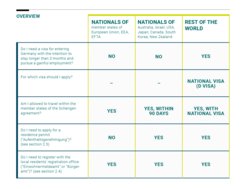
A valid passport and entry visa are necessary when coming to Germany. As a rule, an entry visa (with a short period of validity of 3 months) is valid for the first 90 days and issued by the German embassy in your home country, which can then be converted into a longer-term residence permit.
Your country of origin determines whether you need an entry visa or residence permit at all. For most EU citizens an ID card stating citizenship is sufficient. But in many cases of nationals from Non-EU-Member states, a visa is needed for entry into Germany.
Apply for a visa at a German diplomatic embassy in your own country at least 2-3 months prior to your departure date. Depending on the visa type and the country, different documents for the visa application are required. For further information about the visa application as well as the necessary documents, you should contact the German Embassy or the German Consulate in your home country.
Entry conditions and visas
2. Pre-arrival checklist
As you prepare to leave home please be sure to have the following items with you when traveling to Germany:
- Passport or identity card valid for the entire period of your stay (driving license is not sufficient). If your national identity document is not valid for the entire time, you will have to go back to the German immigration office once it has been renewed by your country of origin.
- Valid visa if applicable (If you want to stay for more than 3 months and start working at the MPI-IE: no C visa/tourist visa/Schengen Visa)
- Travel health insurance (Make sure that you have a valid travel health insurance for the time of your trip and the first few days in Germany)
- (Several) biometric photographs for your residence permit, electronic health card, German driving license
- Marriage certificate and Apostille or Legalization. Both documents must be translated by a certified translation office.
- If you travel with your children: Birth certificate and if you need a visa/residence permit also the Apostille/Legalization of your children’s birth certificate as well as the latest school records
- National driving license
- In case of family planning and having children: Your own birth certificate
- All university certificates (Master/PhD)
3. Translation and Legalisation
We recommend to have legally certified copies and valid translation of your important documents (marriage certificate, birth certificate, university degrees, school reports of your children etc.), when interacting with local German authorities.
Documents in other languages need to be translated into German by a translator who has been sworn in in Germany.
Database of translators and interpreters
Foreign public documents for use in Germany
4. Initial accomodation
Finding accommodation in Freiburg can take time. For your first days or weeks you can book accommodation in one of the Institute’s guesthouses. They are next to the main building on the Institute campus.

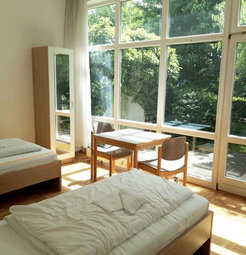
Subject to availability, single, twin, twin for sole use in shared flats and single room apartments can be reserved. Rooms will usually be let for a maximum of six months.
The kitchen in the shared apartments is fully equipped with sink, stove, oven, fridge, microwave and water kettle. The kitchenette of the studio apartment comes with a sink, fridge and stove. Dishes and cooking tools are available.
Shared bathrooms are with shower and bathtub. Bedrooms are furnished with a single bed (or two single beds if it is a double room), a desk and a chair, a closet, a lamp.
Please note: House rules are in place. Towels and bed linen will be provided and replaced weekly. Once a week all floors and bathroom facilities will be cleaned for you. We count on your help and cooperation to keep the rest of the house neat and tidy. Cleaning tools are provided.
Booking: For availability check, booking options and price information, please get in touch with the International Office:


